
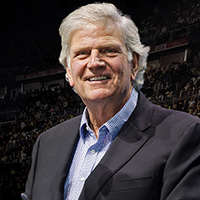
William Franklin Graham III entered the public eye as the eldest son of Billy Graham, but his career has defined a distinct path within evangelical Christianity. Born on July 14, 1952, the fourth child of Billy and Ruth Bell Franklin, he grew up in North Carolina. As a Baylor graduate who earned a law degree, Franklin began his ministry as a youth pastor before moving into large‑scale evangelism. In 1994 he co‑founded Mission USA, a non‑profit that grew into a major global mission organization. As president of the BGEA from 2001 to 2023, he oversaw televised crusades, the expansion of the Hour of Decision program, and the launch of the “Crusade 2000” series that reached billions worldwide.
Beyond broadcasting, Franklin has built a local church, Gospel for a City, into one of the largest congregations in North Carolina. In recent years, Franklin has refocused on digital and youth outreach, launching a “Generation IV” initiative aimed at engaging the next generation of believers through online platforms and socially conscious ministries. His legacy is thus a complex tapestry of evangelistic fervour, political advocacy, institutional leadership, and ongoing efforts to modernize Christian ministry for a rapidly changing cultural landscape. Graham and his wife, Jane Austin, have four children—Will, Roy, Edward, and Cissie—and 13 grandchildren.
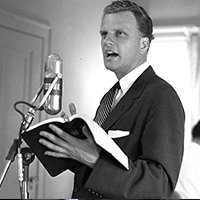 Dr Billy Graham
Billy Graham was born on June 15, 1918 in Charlotte, North Carolina, and from an early age preached in his hometown church before launching the first of his world‑shaping “crusades” in Chicago in 1949. Over the next six decades he conducted twelve major U.S. crusades, five in Africa, and several others in Australia, Japan, and the Philippines, amassing a reach of over 215 million live attendees and millions more through radio, television, film, and the web. His broadcasts—including the long‑running Hour of Decision—became pioneering examples of televised evangelism, while his personal outreach to every U.S. president from Truman to Obama, his early support for civil rights, and his public call for racial reconciliation cemented him as a political and social influencer as well as a religious icon.
Beyond the pulpit, Graham established the Billy Graham Evangelistic Association in 1949 and later the Billy Graham Center at Baylor University, creating structures that promoted transparency, theological scholarship, and the training of future evangelical leaders. His prolific writing—such as The Purpose of Your Life—and his mentorship of figures like Tim Keller, John Stott, and John Piper helped spread a modern evangelical worldview. Graham’s legacy is measured not only by the sheer number of souls he reached but also by the enduring institutions and media platforms he pioneered, which continue to shape Christian evangelism worldwide.